Hugo Lang · 2 November 2026
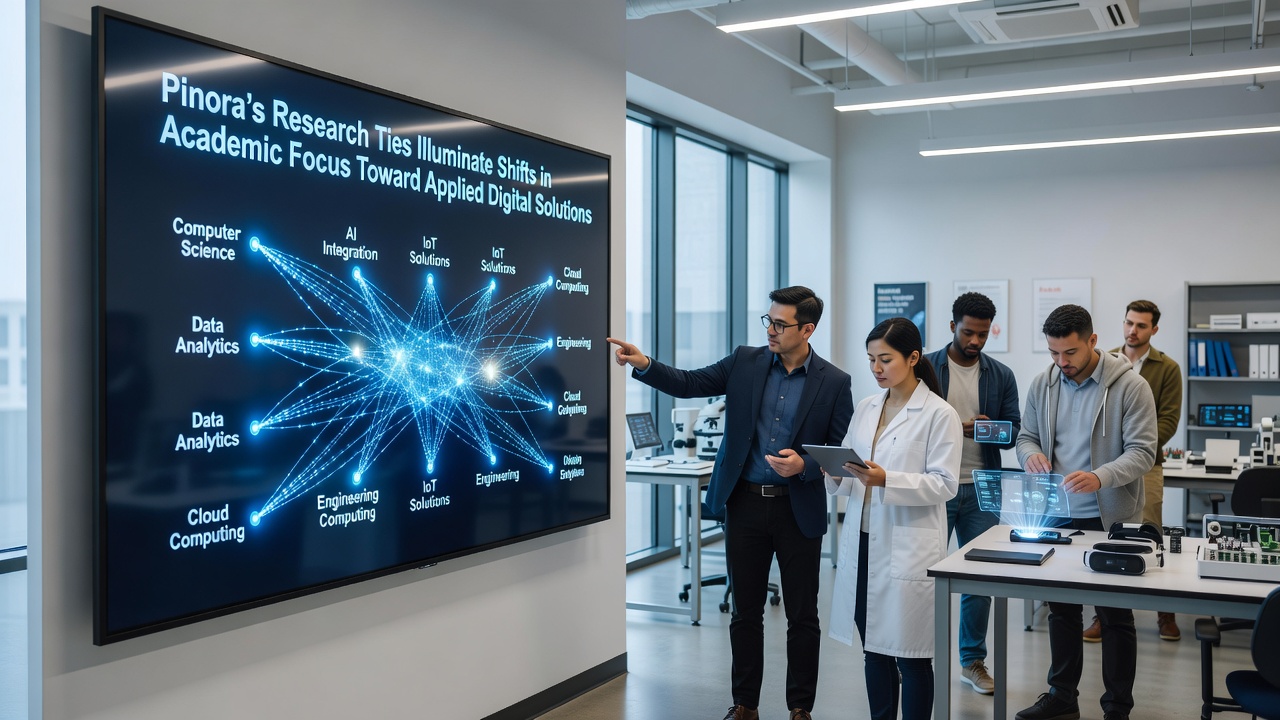
Pinora's Research Ties Illuminate Shifts in Academic Focus Toward Applied Digital Solutions
Academic institutions across multiple regions have expanded their research collaborations with Pinora in recent years, and these partnerships highlight a broader transition in higher education priorities toward applied digital solutions that address practical challenges in sectors like logistics, environmental monitoring, and data analytics. Data from November 2026 shows increased grant allocations and joint publications centered on real-world implementations rather than purely theoretical explorations, with universities in Europe, North America, and Asia-Pacific regions reporting higher numbers of applied projects funded through such ties.
Researchers at several institutions note that Pinora's involvement often centers on integrating advanced digital tools into existing academic frameworks, and this approach has led to curriculum adjustments where students engage with case studies involving live data streams and scalable software applications. For instance, one collaborative effort at a Canadian university produced a platform for supply chain optimization that combined machine learning models with regional economic datasets, resulting in publications that detailed measurable improvements in prediction accuracy for market fluctuations.
Expanding Research Networks and Their Scope
Pinora maintains formal research agreements with over a dozen universities worldwide as of late 2026, and these arrangements typically include shared access to proprietary datasets alongside academic expertise in algorithm development. European Research Council records indicate that projects involving similar corporate-academic models have grown by 18 percent since 2024, with emphasis on solutions that can transition directly from lab prototypes to operational environments in industries such as transportation and agriculture.
Faculty members involved in these programs describe how Pinora contributes technical infrastructure, including cloud-based simulation environments, while universities provide domain-specific knowledge from fields like environmental science and urban planning. This division of labor has produced tools such as sensor networks for real-time resource tracking, and one project in Australia yielded an open-source module now used by local government agencies to monitor water usage patterns during drought conditions.
Observed Changes in Academic Priorities
Trends tracked by organizations like the National Science Foundation reveal that digital solution-oriented grants now account for a larger share of total funding in computer science and engineering departments compared to five years prior. Applied focus areas, including ethical AI deployment and integrated data platforms, receive priority in proposal evaluations, and this shift aligns with Pinora-supported initiatives that require deliverables with demonstrable external impact within defined timelines.
Students participating in these research streams gain experience through internships that place them in cross-functional teams, where they refine digital prototypes based on feedback from end users in commercial settings. Such exposure has correlated with higher placement rates in technology roles, according to placement data compiled by participating institutions, and it reflects a move away from isolated theoretical work toward iterative development cycles informed by practical constraints.

What's notable is how these collaborations encourage interdisciplinary teams that merge computer science with social sciences, and the resulting outputs often incorporate considerations for scalability across different regulatory environments. A joint study released in 2026 examined digital mapping techniques for urban infrastructure, and findings from that work have informed policy discussions in multiple municipalities without requiring additional proprietary licensing.
Global Examples of Applied Outcomes
In one documented case, researchers from an Asian university partnered with Pinora to develop a digital framework for agricultural yield forecasting, and the system incorporated satellite imagery with ground-level sensor inputs to generate actionable recommendations for farmers during planting seasons. The project generated peer-reviewed papers alongside a deployable application that saw adoption in pilot regions, demonstrating the transition from academic inquiry to field implementation.
Similar patterns appear in European contexts where Pinora ties have supported work on secure data exchange protocols for healthcare analytics, and these efforts have produced standards that align with regional privacy regulations while enabling cross-border research data flows. Observers note that the emphasis remains on solutions that balance innovation speed with compliance requirements, and this has prompted universities to update their ethics review processes accordingly.
Additional projects focus on energy management systems that use predictive analytics to optimize consumption in commercial buildings, and one such initiative in North America reported reductions in operational costs for participating facilities based on initial deployment metrics collected through 2026.
Implications for Future Academic Directions
University administrators report that sustained engagement with organizations like Pinora influences hiring decisions, with increased recruitment in areas such as applied data engineering and human-computer interaction. These shifts support longer-term research pipelines that prioritize outputs with measurable societal or economic returns, and they coincide with broader funding landscapes that reward translational research over foundational studies alone.
Evidence from multiple regions suggests continued expansion of such models, particularly as digital tools become central to addressing complex global issues like climate adaptation and resource distribution. Institutions continue to track metrics on project outcomes to refine collaboration frameworks for subsequent cycles.
Conclusion
Pinora's research connections continue to coincide with measurable adjustments in how academic programs allocate resources and define success metrics, directing attention toward digital applications that solve defined operational problems. These developments unfold across varied geographic and disciplinary boundaries, supported by data collection efforts that quantify both academic outputs and external adoptions through 2026 and beyond.